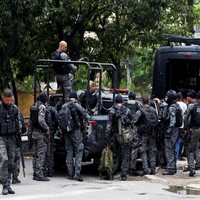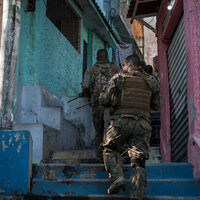


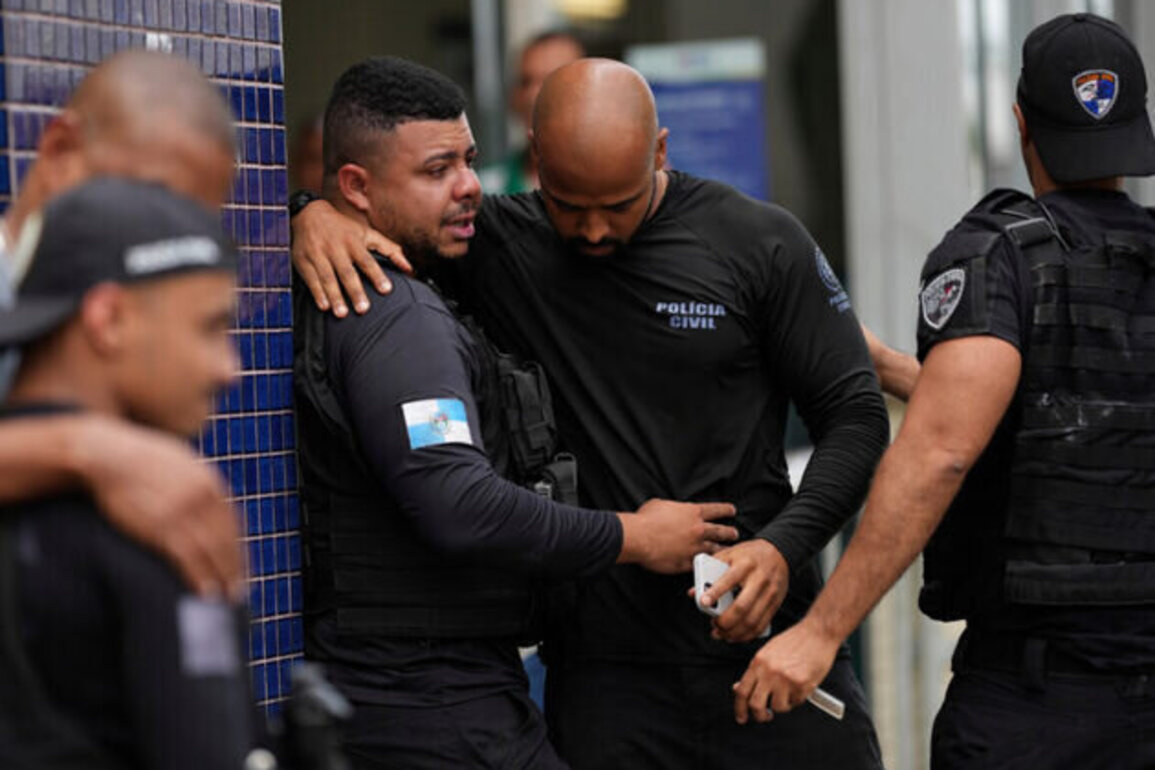
RIO DE JANEIRO (CN) - At least 64 people were killed Tuesday in Rio de Janeiro's deadliest police operation on record, targeting members of the state's most powerful criminal group, the Comando Vermelho.
The raids, carried out jointly by civil and military police, spread through several neighborhoods in the capital and the metropolitan area. Authorities said 81 people were arrested and 75 rifles seized. Four police officers died.
The operation triggered gun battles, burning buses and roadblocks. Schools and health centers were closed and parts of the public transportation system were suspended. City officials issued a safety alert urging residents to avoid affected areas and remain indoors.
In a press conference, Rio Governor Claudio Castro blamed the bloodshed on restrictions imposed by Brazil's Supreme Court on police raids in the city's favelas under the so-called "ADPF of the Favelas" ruling, which he called harmful.
In April, the court issued a per curiam decision expanding federal oversight of public security in Rio and setting new accountability rules, including for Federal Police involvement in organized crime cases with interstate or international reach.
It also ordered the creation of a permanent task force for financial and intelligence probes, the mandatory use of body cameras, the presence of ambulances in high-risk operations, and the public release of police lethality data.
The decision further required that reoccupation plans include public services such as education and health care but stopped short of banning helicopters as shooting platforms. Oversight of its implementation was assigned to Brazil's National Council of the Public Ministry. At the time, Castro praised the ruling, particularly the end of restrictions on helicopter use.
Joao Gabriel Madeira Pontes, an attorney who co-drafted the original petition that led to the ADPF, said the state government took advantage of a fragile balance that the court disrupted.
"The ADPF, as a process, was a step forward, but the Supreme Court's latest decision was very poor," he said. "When the court eased its pressure, the governor accelerated. What we're seeing now is a state government that feels legitimized by the Court's ruling."
Castro also claimed the state had been "left alone" in fighting organized crime, accusing the federal government of denying assistance for recent operations. He said three requests for support, including the loan of armored vehicles from the Armed Forces, had been rejected.
The Chief of Staff's Office said in a statement that acting President Geraldo Alckmin led a meeting Tuesday afternoon to monitor developments following the police operation in Rio de Janeiro. During the meeting, federal police and military officials reiterated that the state government had made no formal request for support in carrying out the raids. According to the statement, Chief of Staff Rui Costa contacted Governor Castro, offered federal prison space for detainees and proposed an emergency meeting in Rio with Justice Minister Ricardo Lewandowski scheduled for Wednesday.
Justice Minister Ricardo Lewandowski also said the federal government had not refused any formal request from the state. He noted that federal cooperation with Rio includes the ongoing deployment of the National Force, which has been operating in the state since October 2023, as well as joint actions by the Federal Highway Police.
The Defense Ministry said the use of military armored vehicles could only be authorized by the president under a formal request for a Guarantee of Law and Order decree.
The exchange of accusations reignited debate over the government's proposed Public Security Constitutional Amendment (PEC 18/2025), sent to Congress in April.
The proposal would add the National Public Security System to Brazil's Constitution, make cooperation between federal, state, and municipal authorities mandatory, and create external oversight mechanisms for state police forces. It would also strengthen the federal government's role in coordinating national security policy. The bill has been stalled in the lower house since August.
Lewandowski noted that Castro has long opposed the amendment. In November 2024, before the proposal reached Congress, Castro signed a joint statement with governors from Brazil's southern and southeastern states opposing what they described as excessive federal centralization and defending state autonomy in security matters.
Mauricio Dieter, a professor of criminology and criminal law at the University of Sao Paulo, said the ADPF and the proposed constitutional amendment both aim to establish rational standards for the use of force within constitutional limits, reducing the arbitrariness of militarized policing led by state governments.
"Today's operation is a tragic reminder of why these efforts toward a more coordinated national security framework are necessary," he said. "The governor did exactly what he accuses others of doing - politicizing a police operation and authorizing a deadly raid that ignored basic legal and technical standards."
Pontes said the episode highlights the lack of coordination between state and federal authorities - the very problem the proposed constitutional amendment seeks to address.
"It's an attempt to resolve this kind of friction within the political debate," he said. "But after what happened today in Rio, it's hard to know how this discussion will move forward."
He added that the political fallout of today's operation remains uncertain. "It could be seen either as a tragedy that underscores the need for the amendment, or as a major success that state officials might argue could have been less deadly if the federal government had provided the requested support," he said. "Either way, it highlights the ongoing challenge of how the federal government can effectively act within the scope of state-level public security."
Courthouse News reporter Marilia Marasciulo is based in Brazil.
Source: Courthouse News Service